Slovenia’s self-employed permit is an EU sleeper — 4% effective tax for qualifying small business, Alpine + Adriatic geography in one country, and quiet PR path. Verified 2026 detail.
Last verified: May 26, 2026.
Single Permit for Self-Employed overview
- Income: viable business plan + reserves ~€10,000
- Validity: 1 year, renewable, PR after 5 years
- Tax: ‘normirani’ (normalized lump-sum) — 4% effective for small-business under €100K revenue
- EU + Schengen
- Cost: €102 application + €40 ID card
Why Slovenia works
- Normirani tax regime — 4% effective is one of EU’s best for small business
- Alpine + Adriatic + Mediterranean — three climate zones in one country
- Strong English usage, especially in Ljubljana
- Underrated quality of life — small, safe, scenic
Eligibility requirements
- Non-EU citizen
- Slovenian business registration (s.p. or d.o.o.)
- Business plan demonstrating viability
- Slovenian rental contract
- Health insurance
- Criminal record apostilled
Cost of living — Slovenia 2026
- 1-bed Ljubljana center: €700-1,000/month
- 1-bed coastal (Koper/Piran): €600-900/month
- Restaurant meal: €12-22
- Couple comfortable monthly: €1,800-2,800
Slovenia self-employed permit — application process
Slovenia’s single permit for self-employed is one of the EU’s most flexible — combining work permit, residence permit, and tax registration in one document. Verified 2026 process:
- Step 1 — Register a Slovenian business (s.p. or d.o.o.). Most freelancers use “samostojni podjetnik” (s.p.) — a sole proprietorship.
- Step 2 — Prepare business plan. Slovenia is one of the few EU countries that requires a viable business plan as part of the application — typically 5-10 pages demonstrating clients, revenue projection, market need.
- Step 3 — Submit application at Slovenian embassy/consulate abroad OR at the Administrative Unit in Slovenia (if you are visa-exempt). Required: business plan, registered Slovenian business, accommodation proof, bank reserves €10,000+, criminal record, health insurance, qualifications evidence.
- Step 4 — Wait for approval (60-90 days).
- Step 5 — Collect single permit at Administrative Unit. Valid 1 year, renewable.
- Step 6 — Register at municipality + tax authority + health insurance (ZZZS).
- Step 7 — Apply for normirani tax regime within 8 days of registration to qualify for the simplified flat-rate scheme.
The normirani regime — why Slovenia’s tax math works
Slovenia’s “normalizirana” tax regime is one of the EU’s most underrated:
- Annual revenue cap: €100,000.
- Deemed expense ratio: 80% of revenue (you do not need to track actual expenses).
- Effective tax on remaining 20%: ~20% flat.
- Combined effective rate: ~4% on gross revenue — among Europe’s lowest.
Example: freelancer with €60,000 revenue under normirani. Deemed expenses €48,000. Taxable base €12,000. Tax ~20% = €2,400. Plus mandatory social contributions ~€4,200/year (PIZ + ZPIZ + ZZZS combined). Total annual obligations: ~€6,600 on €60,000 gross. Net effective rate: 11%.
Ljubljana + Slovenian coast — practical bases
Ljubljana
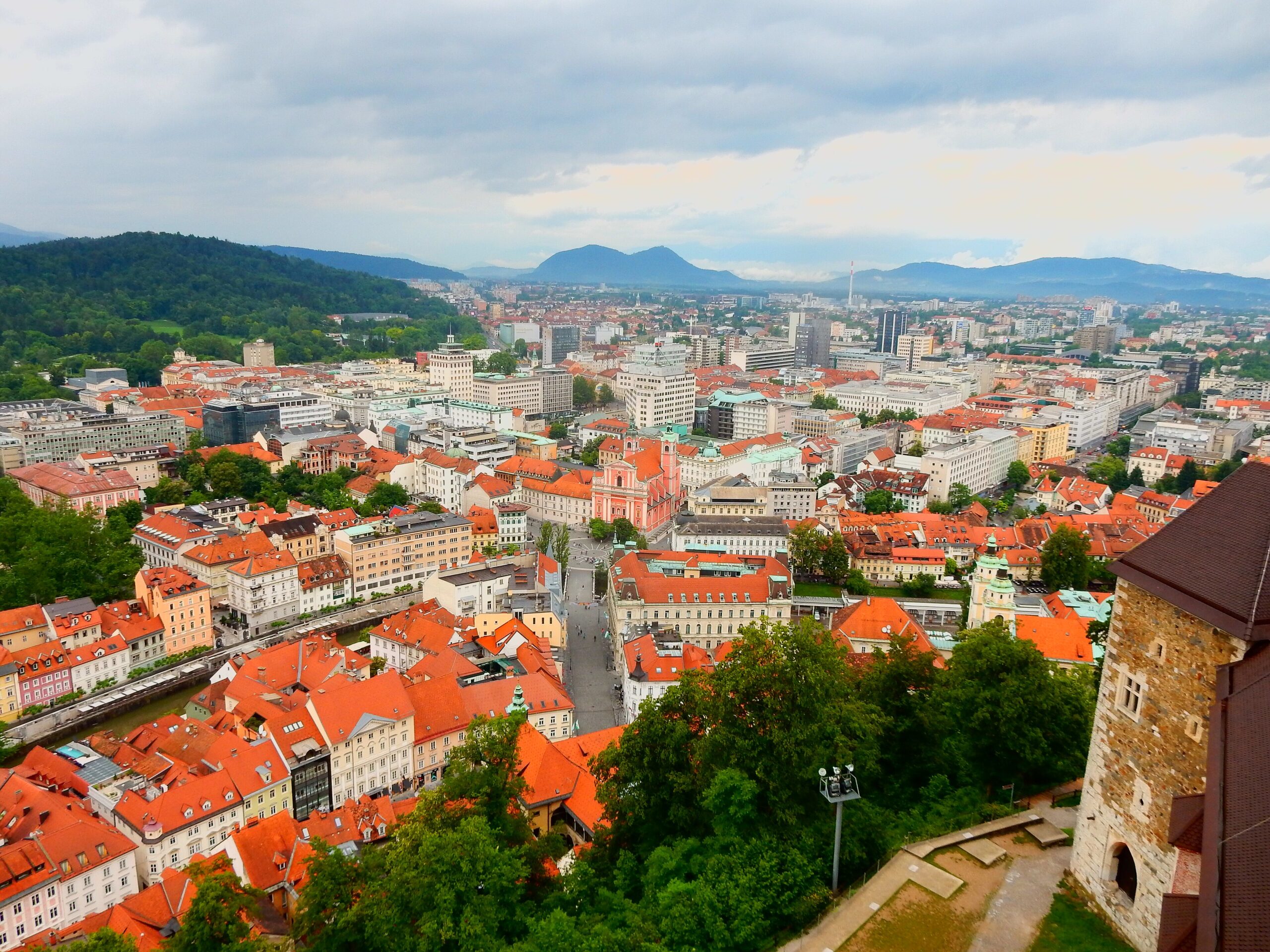
Capital, university town, growing tech scene (Outfit7, Cosylab). Beautiful old town, river runs through center. 4 cafes per 1,000 residents (one of Europe’s highest densities). 1-bed €700-€1,000. Fiber internet 500 Mbps for €30/month. Coworking: WeCo, Poligon, Cocoworking.
Koper / Piran (coast)
Slovenian Adriatic coast. Piran is a UNESCO-protected Venetian-era town. 35 km from Trieste, Italy. Slower pace, smaller community, mild Mediterranean climate. 1-bed €600-€900.
Maribor
Second city, wine region, much cheaper. Less expat infrastructure. 1-bed €350-€600. Good for budget-conscious nomads who want quieter life.
Why Slovenia is underrated
Slovenia consistently ranks in the top 5 EU countries for quality of life, environmental performance, and safety. Yet it has ~10x fewer expats than Portugal or Spain. Reasons more nomads should consider it:
- Alpine + Adriatic + Mediterranean climates all within 2 hours by car
- Bordered by Italy, Austria, Hungary, Croatia — 4 cultures within driving distance
- Strong English fluency in Ljubljana (top 5 globally for non-native English)
- Lower cost of living than Portugal’s Lisbon, Spain’s Madrid, or Italy’s Milan
- EU + Schengen + Eurozone all together
- 5-year PR + 10-year citizenship track
More FAQ
Will I lose normirani if my revenue exceeds €100,000?
Yes — exceeding €100,000 revenue forces you out of normirani for the following tax year. You move to standard accounting (actual expense tracking, progressive 16-50% tax). Many high-earning Slovene freelancers structure to stay just under the €100K cap, or upgrade to a d.o.o. (limited company) at higher revenue.
Slovenian health insurance — public or private?
Self-employed permit holders must enroll in ZZZS (public health insurance) — mandatory. Most freelancers supplement with private add-ons (Triglav Zdravje, Adriatic Slovenica) for €30-€60/month covering dental, faster specialist access, private hospital options. Slovenian healthcare is consistently rated among Europe’s top 10.
FAQ
What is the ‘normirani’ regime?
Slovenian lump-sum tax for freelancers under €100K revenue. Effective tax can drop to ~4% (it’s a deduction of 80% of revenue, with the remaining 20% taxed at 20%). Talk to a Slovenian accountant before assuming it’ll work for your case.
Banking + practical setup in Slovenia
Top banks for foreign residents: NLB, Nova KBM, Sberbank Slovenia. NLB is national leader. Account opening requires EMŠO (personal ID number) issued upon municipal registration. Minimum opening deposit €10-€100. Many newcomers use a Wise multi-currency account in parallel with local bank for first 3-6 months while local account paperwork completes.
Cultural notes — what newcomers should know
Slovenes are reserved, punctual, environmentally conscious. Ljubljana shuts down on Sundays. Coastal Slovenia (Koper, Piran) has strong Italian influence + Italian-language signage. Mountain towns observe early closures (most kitchens 9pm).
More FAQ
Time zone working from Slovenia?
Slovenia operates in GMT+1/+2. This is favorable for collaboration with EU clients (most of EU same zone). For US East Coast remote work: 6-hour difference (your 9am = their 3am EST). For US West Coast: 9-hour difference. Asia-Pacific: 5-8 hours behind. Plan async-first work with morning sync windows for US East.
Language barrier in Slovenia?
Slovene (English widely spoken in Ljubljana + Koper). In the capital and tech districts, English-only operation is viable for most daily life — banking, healthcare, restaurants, transport. Outside major cities, expect local language only. Budget 3-6 months of basic local-language learning (italki, Duolingo, in-person classes) for confident integration.
Best season to arrive in Slovenia?
Most administrative offices in Slovenia slow significantly in July-August. April-May or September-October are typically the smoothest months for residency permit applications, business registration, and bank account opening. Winter months can extend processing by 2-4 weeks.
Related: full visa comparison · Portugal D7 · Spain NLV.
✓ Last verified: May 26, 2026.
Further reading
- Netherlands visa guide 2026: DAFT, startup visa, highly skilled migrant and more
- Turkey residency guide 2026: short-term permit, property route and citizenship
- Costa Rica visa guide 2026: pensionado, rentista and investor residency
- Georgia visa and residency guide 2026: the ultimate low-tax expat base
- Panama visa guide 2026: Pensionado, Friendly Nations and investor routes