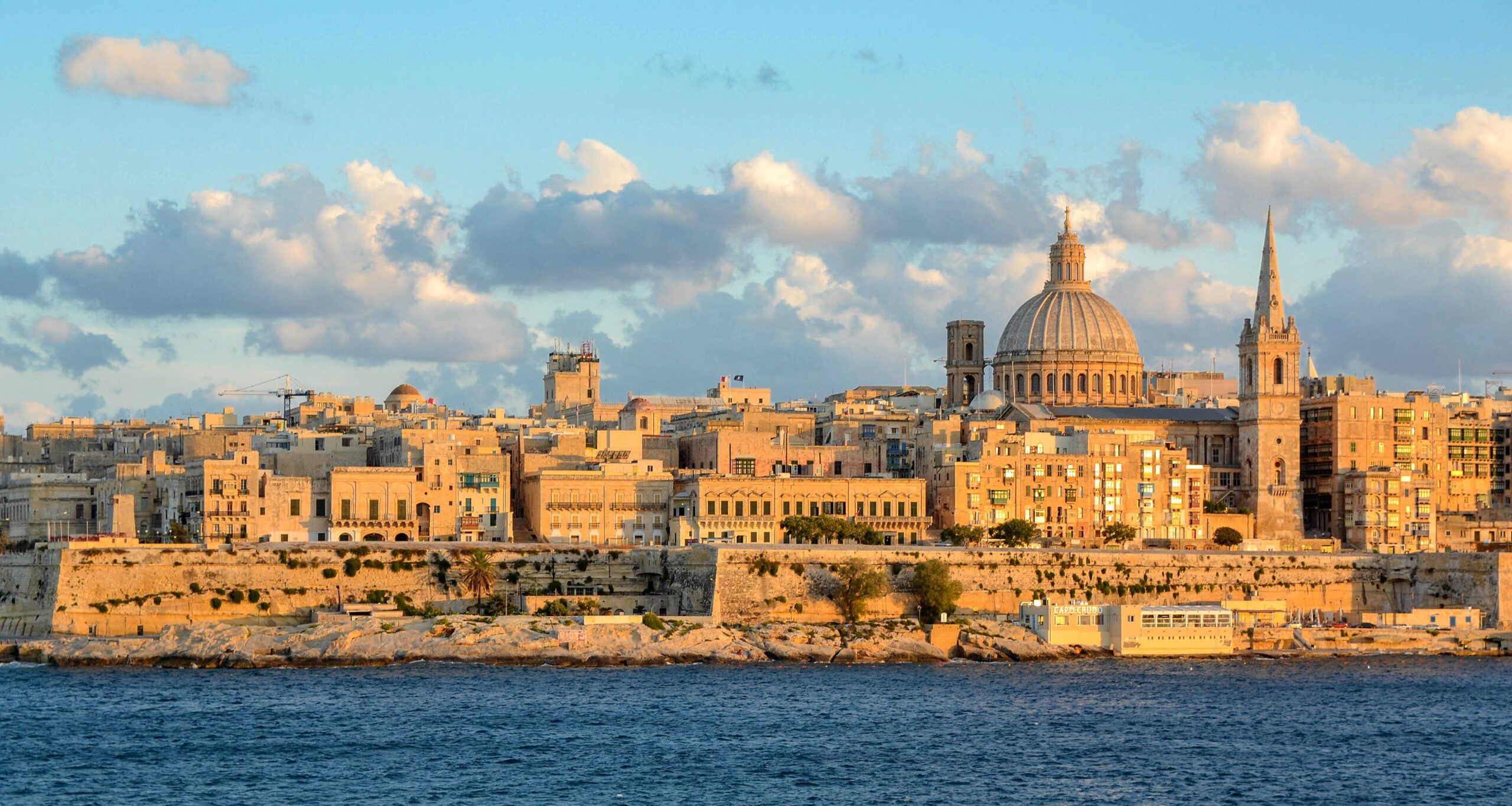
Malta’s Retirement Programme combines EU residency, English-everywhere ease, and a 15% flat tax on remitted foreign income. Two tracks (MRP and GRP) suit different income profiles. Here’s the verified 2026 detail.
Last verified: May 26, 2026.
Retirement Programme (MRP) overview
- Income threshold: Two tracks — MRP (€7,500/year + €500/dep), or Global Residence Programme (€40,000+/year + €100K capital)
- Validity: annual renewal, indefinite extension
- Tax: 15% flat on foreign income remitted to Malta — minimum tax €7,500/year
- Cost: €5,500 government fee + property/rental minimums
- EU + Schengen access
- English is official language
Why Malta works
- Predictable 15% flat tax on remitted foreign income
- English everywhere — official language alongside Maltese
- Schengen + EU access
- Mediterranean climate, safe, low-crime
- Healthcare system strong (public + private)
Eligibility requirements
- Non-EU/EEA citizen
- Property purchase ≥€220K (Malta) / €275K (Gozo); OR rent ≥€8,750/yr (Malta) / €9,600/yr (Gozo)
- Health insurance covering Malta + EU
- Pension income or proven passive income
- Clean criminal record + tax compliance proof from home country
Cost of living — Malta 2026
- 1-bed Sliema/Valletta: €1,000-1,500/month
- 1-bed Gozo: €650-1,000/month
- Restaurant meal: €15-30
- Couple comfortable monthly: €2,500-3,800
MRP application process — Malta step by step
The Malta Retirement Programme (MRP) application is more involved than most EU retirement visas — Malta uses an Authorised Registered Mandatary (a licensed advisor) who must submit on your behalf. Verified 2026 process:
- Step 1 — Appoint an Authorised Registered Mandatary (ARM). This is a Maltese-licensed advisor (law firm or accounting firm). Fees typically €5,000-€10,000 for the full MRP application package.
- Step 2 — Secure qualifying property. Either purchase property ≥€220,000 (mainland) or €275,000 (Gozo), OR rent at ≥€8,750/year (mainland) or €9,600/year (Gozo).
- Step 3 — Submit Form MRP-1 application via your ARM. Includes apostilled birth/marriage certificates, criminal record, tax compliance proof from home country, full income/asset documentation.
- Step 4 — Pay €5,500 government fee on submission.
- Step 5 — Wait for IRD letter of approval (8-12 weeks typical).
- Step 6 — Move to Malta + register annual residence. Annual residence permit issued (renewable indefinitely).
- Step 7 — File annual MRP tax return. Minimum €7,500/year MRP tax (€500 per dependent).
MRP vs Global Residence Programme (GRP) — full comparison
- MRP minimum stay: 90 days/year in Malta minimum. GRP: no minimum stay requirement.
- MRP minimum tax: €7,500/year. GRP: €15,000/year minimum.
- MRP property minimum: €220,000 purchase / €8,750 annual rent. GRP: €275,000 purchase / €9,600 annual rent.
- MRP target: retirees with EU/EEA/Swiss citizenship currently outside Malta. GRP target: third-country nationals.
Real cost of MRP residency — full first-year picture
- Government application fee: €5,500
- Authorised Registered Mandatary fees: €5,000-€10,000
- Apostille + translations: €300-€600
- Rental deposit + first month (Sliema 1-bed €1,000-€1,500): €2,000-€4,500
- Annual property minimum cost: €8,750-€9,600
- Minimum MRP tax: €7,500
- Private healthcare (couple 60+): €2,400-€4,800/year
- Total first-year all-in (excluding moving/furniture): €31,000-€42,000
Why Malta — and why some retirees regret it
Malta’s pros are real: English everywhere, Schengen + EU access, 15% flat tax on remitted income, year-round Mediterranean weather, low crime, robust healthcare. Among retirees who relocate to Malta from the UK or US, satisfaction surveys consistently show 70-80% would recommend it.
The cons are also real:
- Density. Malta is one of the world’s most densely populated countries. Traffic in summer is brutal. Sliema, Valletta, St. Julian’s feel crowded year-round.
- Construction noise + dust. Malta has been in a building boom for 10+ years. Most central areas have ongoing construction.
- Limited nature. If you love hiking, biking, or wilderness — Malta is small and largely developed.
- Summer heat. July-September can hit 40°C with humidity. Many retirees travel to Sicily, mainland Italy, or Spain in summer.
- Gozo is the better fit for many retirees. Quieter, less crowded, more rural — but you trade off island convenience.
More FAQ
Can I become a Maltese citizen via MRP?
Not directly — MRP is residency, not a citizenship track. Malta’s naturalization (10 years residency for ordinary citizenship, 13 years for non-EU) is separate. There is also the Malta Exceptional Investor Naturalization (MEIN) program for HNW applicants, but that requires €690,000+ contribution + 36 months residency.
Is MRP affected by Malta’s 2023 changes to non-dom + IIP?
MRP itself has been stable through the 2023-2025 reforms. The bigger changes have affected the residency-by-investment (IIP/MEIN) and standard non-domicile tax rulings. MRP remains a separate, retiree-specific program with its own framework.
FAQ
MRP vs Global Residence Programme — which?
MRP is cheaper but requires you to live in Malta as your primary residence (90+ days/year minimum). GRP is more flexible (fewer day-count rules) but higher minimum tax (€15,000/year). Most retirees pick MRP.
Is the 15% flat tax on all foreign income?
Only on income *remitted* to Malta. Foreign income kept outside Malta is generally not taxed (with caveats). This is why high-asset retirees often pair MRP with offshore structures — talk to a Malta tax advisor before assuming.
Banking + practical setup in Malta
Top banks for foreign residents: Bank of Valletta, HSBC Malta, APS Bank. HSBC Malta is most international-friendly. Account opening for MRP holders requires residence permit + property/rental contract + tax ID number. Many newcomers use a Wise multi-currency account in parallel with local bank for first 3-6 months while local account paperwork completes.
Cultural notes — what newcomers should know
Maltese culture blends Italian, Arab, British influences. English official + universal. Malta packs 500K people into 316 km² — density rivals Hong Kong outside Asia. Catholic festivals (festas) central to summer life.
More FAQ
Time zone working from Malta?
Malta operates in GMT+1/+2. This is favorable for collaboration with EU clients (most of EU same zone). For US East Coast remote work: 6-hour difference (your 9am = their 3am EST). For US West Coast: 9-hour difference. Asia-Pacific: 5-8 hours behind. Plan async-first work with morning sync windows for US East.
Language barrier in Malta?
Maltese + English both official. In the capital and tech districts, English-only operation is viable for most daily life — banking, healthcare, restaurants, transport. Outside major cities, expect local language only. Budget 3-6 months of basic local-language learning (italki, Duolingo, in-person classes) for confident integration.
Best season to arrive in Malta?
Most administrative offices in Malta slow significantly in July-August. April-May or September-October are typically the smoothest months for residency permit applications, business registration, and bank account opening. Winter months can extend processing by 2-4 weeks.
Related: full visa comparison · Portugal D7 · Spain NLV.
✓ Last verified: May 26, 2026.
Further reading
- Netherlands visa guide 2026: DAFT, startup visa, highly skilled migrant and more
- Turkey residency guide 2026: short-term permit, property route and citizenship
- Costa Rica visa guide 2026: pensionado, rentista and investor residency
- Georgia visa and residency guide 2026: the ultimate low-tax expat base
- Panama visa guide 2026: Pensionado, Friendly Nations and investor routes