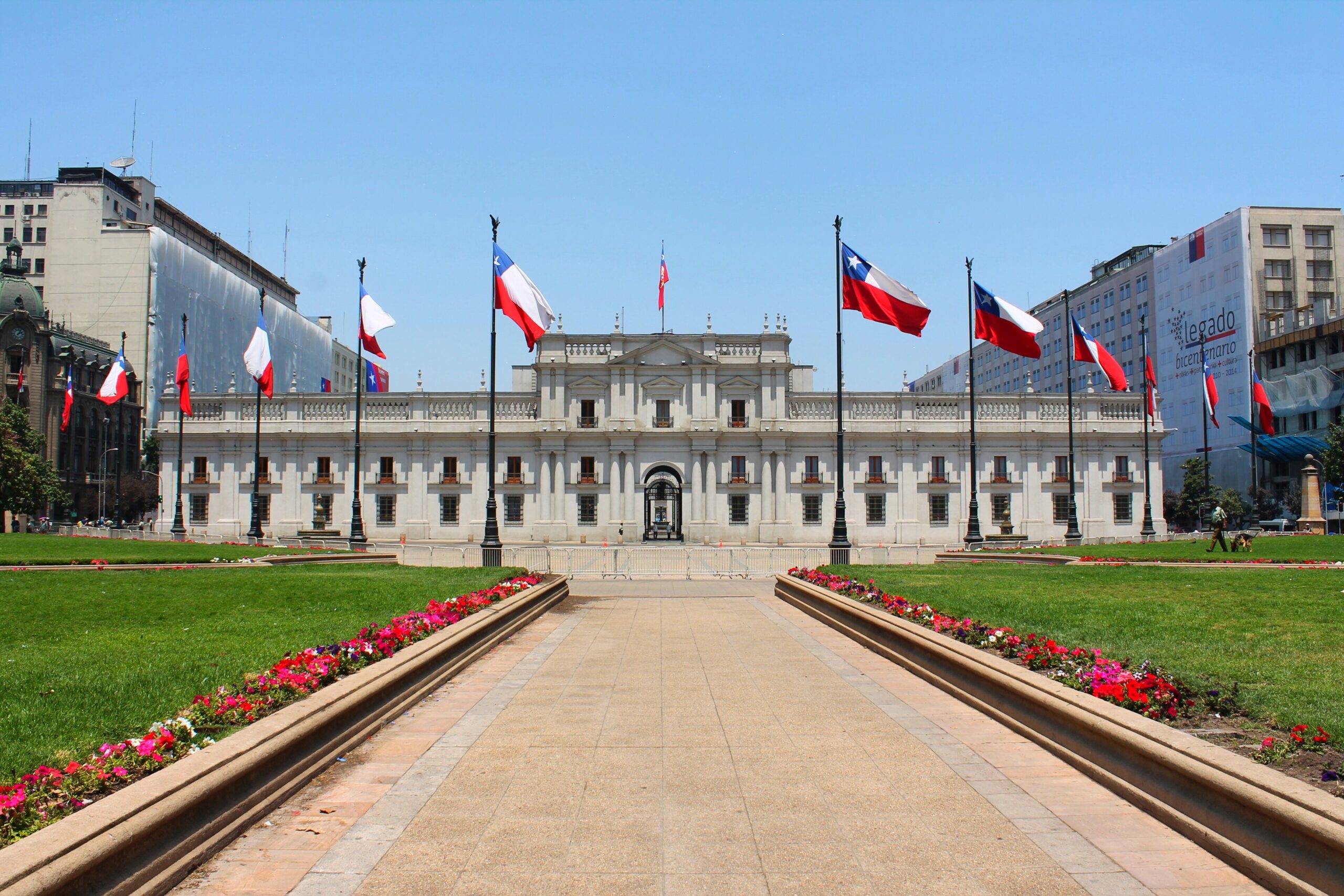
Chile is the most developed Latin American country — Santiago has the region’s best infrastructure, the wine country is world-class, and Patagonia + the Atacama are bucket-list destinations. Residency routes are more bureaucratic than Panama or Paraguay but offer the highest baseline quality of life. Verified 2026 detail.
Last verified: May 26, 2026.
Temporary Residence Visa (Sujeción a Contrato or Pensioner) overview
- Most viable routes: Pensioner/Rentista, Work Sujeción a Contrato, Student, Investor
- Income: case-by-case but typically $2,000+/month for rentista/pensioner
- Validity: 1-year temporary residency, PR after 2 years
- Citizenship: 5 years from PR
- Cost: ~$420 USD (varies by nationality)
Why Chile works
- Most economically developed country in Latin America
- Excellent infrastructure (best in region) — internet, transport, healthcare
- Stable currency, no major inflation concerns
- Spectacular geography — Atacama desert (north), Patagonia (south), wine country (central)
- Santiago is one of safest, most modern Latin American capitals
Eligibility requirements
- Income or savings proof
- Clean criminal record (apostilled, Spanish)
- Health insurance Chile-valid OR Fonasa public enrollment
- RUT (Chilean tax ID) — get this in first weeks
Cost of living — Chile 2026
- 1-bed Santiago (Providencia, Las Condes): $600-1,200/month
- 1-bed Valparaíso/Viña del Mar: $500-900/month
- Restaurant meal: $8-15
- Couple comfortable monthly: $2,000-3,200 USD
FAQ
Why is Chile less popular for retire-abroad than Colombia or Costa Rica?
Higher cost than other Latin destinations + higher threshold + slower process. Trade-off: best infrastructure, safest cities, most developed economy in region. Pick Chile for quality/stability over savings.
Temporary Residence Visa application — step by step
Step 1. Apply at Chilean consulate in home country OR through ANI online portal. Chile reformed its immigration system in 2022 — most applicants now use ANI digital application.
Step 2. Required: passport, documentation matching visa category (pension proof, employment contract, investment proof). Typical income demonstration: $2,000+/month.
Step 3. Application fee: ~$420 USD (varies by nationality).
Step 4. Processing: 4-8 months typical.
Step 5. Receive 1-year temporary residency. Apply for RUT (tax ID) + register at municipality + enroll in Fonasa or Isapre (health system).
Step 6. Apply for permanent residency after 2 years temporary. Citizenship eligible after 5 years total residency.
Banking + practical setup in Chile
Major banks: Banco de Chile, BancoEstado, Banco Santander Chile, Banco BCI.. Banco de Chile + Banco Santander most foreigner-friendly. Account requires RUT (Chilean tax ID issued at Servicio de Impuestos Internos), passport, residence permit, initial deposit (~$100).
Cultural notes for newcomers
Chile is most economically developed in Latin America. Strong rule of law, low corruption. Spanish (with distinctive Chilean accent that drops syllables — challenging for Spanish learners). Atacama desert, Patagonia, wine country, Santiago metro area all very distinct.
Real cost of living + practical lifestyle
Santiago (Providencia, Las Condes) couple lifestyle: $2,200-$3,500/month. Valparaíso/Viña del Mar (coast): $1,900-$2,800. Healthcare: Clínica Las Condes, Clínica Alemana — private Isapre plans $150-$400/couple/month.
Most common newcomer pitfall
Chile’s 2022 immigration reform tightened previously casual rules — informal residency through repeated tourist entries no longer works. Plan formal application from start.
How Chile compares to peers
Vs Argentina: Chile more stable economy + safer + better infrastructure but more expensive (no Argentine post-reform discount). Argentina has more dramatic culture + faster citizenship (2 vs 5 yrs).
Additional FAQ
Best time to arrive in Chile?
Most LATAM administrative offices slow significantly during Christmas/New Year + Easter Week (Semana Santa). January (post-holiday catch-up) and September-November tend to be the smoothest months for residency applications, banking, and rental searches.
Can I bring my US/EU/Canadian driver license?
Most LATAM countries honor foreign driver licenses for 90-180 days as a tourist. After residency, you generally need to obtain a local license — sometimes via simple conversion (Costa Rica, Panama, Mexico), sometimes via local test (Brazil, Argentina). International Driving Permit (IDP) recommended for the transition period.
Healthcare for retirees in Chile?
Public systems vary widely (Costa Rica’s Caja excellent; Bolivia’s very limited). Most expat retirees combine: cash for routine care (often dramatically cheaper than US — $30-60 specialist visits), private insurance for catastrophic ($100-$400/couple/month for Cigna, Bupa, local equivalents), and travel back to home country for very complex procedures if needed.
Why this country in 2026 specifically
Chile is Latin America’s most economically developed country — best infrastructure, safest cities, strongest rule of law, lowest corruption. For retirees who prioritize first-world reliability over budget-tier costs, Chile beats most regional alternatives. Santiago has Latin America’s best metro system, Wi-Fi consistently 200+ Mbps in urban areas, and grocery + restaurant + service availability comparable to US Tier-2 cities.
Chile’s 2022 immigration reform closed previous casual residency paths (informal “border bouncing” no longer works) but legitimized formal residency tracks. Healthcare system (Isapre private + Fonasa public) consistently ranks Latin America top-3. Wine country (Maipo, Casablanca, Colchagua valleys) provides retirement-friendly micro-climates within 1-2 hours of Santiago. Patagonia’s Aysén + Magallanes regions offer dramatic landscapes but very different climate.
Even more FAQ
How does Chile compare to Argentina for retirees right now?
Chile is more stable, safer, better infrastructure — and 30-50% more expensive. Argentina post-Milei reforms is much cheaper than Chile + has faster citizenship (2 vs 5 years) + more cultural depth in Buenos Aires. Both countries are objectively good retirement destinations; choice depends on price-tolerance vs stability-preference.
Is Patagonia viable for retirement?
Puerto Varas + Pucón (Lakes Region) attract retirees wanting Patagonian landscape with reasonable services. Punta Arenas (deep south) is harsher climate + limited services but unique. Most “Patagonian retirement” is actually in the Lakes Region between Temuco + Puerto Montt — milder climate, more retiree infrastructure, easier flights to Santiago.
Related: full visa comparison · Mexico Temporary Resident · Best places to retire abroad.
✓ Last verified: May 26, 2026.
Further reading
- US F-1 student visa 2026: complete application guide, financial requirements, OPT and H-1B pathway
- Countries with golden visa programs in 2026: investment requirements, residency rights, citizenship pathways
- Erasmus+ 2026: monthly grants, how to apply, Erasmus Mundus Joint Masters, Turing Scheme for UK
- Masters in Australia for international students 2026: tuition, Student visa, post-study work permit
- Masters in Canada for international students 2026: tuition, Study permit, PGWP, Express Entry