Colombia is one of the most interesting relocation destinations in Latin America: a genuinely diverse country with world-class cities, improving infrastructure, and a visa system that is among the most accessible in the region. Here is the complete guide for 2026.
Colombia’s visa categories
| Visa category | Who it’s for | Key requirement | Duration |
|---|---|---|---|
| V Digital (Digital Nomad) | Remote workers employed by non-Colombian companies | Proof of foreign income | 2 years, extendable |
| V Trabajo (Work) | Employees of Colombian companies | Colombian employer contract + immigration approval | Employer-defined |
| R Pensionado (Retirement) | Retirees with qualifying pension | 3× Colombian minimum wage/month pension (~USD 850) | Permanent (R visa) |
| M Migrante (Investment) | Property investors or business investors | ~USD 27,000 real estate investment | 3 years → renewable |
| R Acumulacion de Tiempos | 5 years of continuous V visas | 5-year visa history | Permanent (R visa) |
| TP Turismo (Tourism/Digital Nomad stop-gap) | Tourists staying under 90 days | Most Western passports visa-free | 90 days, extendable once |
V Digital — Colombia’s Digital Nomad Visa
Colombia introduced a dedicated Digital Nomad Visa (Visa Tipo V, subcategory Digital Nómada) in 2022. Requirements: proof of remote work or freelance income from clients or employers outside Colombia — there is no defined minimum income amount in the regulations (unlike many other countries’ DNVs), but the Cancillería (Ministry of Foreign Affairs) expects demonstrated financial sustainability. In practice, bank statements showing equivalent of approximately USD 750 to 1,000 per month consistent income is the minimum that gets approved.
The V Digital is valid for 2 years and can be extended once. Holders are allowed to perform remote work for non-Colombian clients or employers only — work for Colombian companies requires a separate V Trabajo permit. The visa costs approximately USD 177 to apply online through the Cancillería portal. Processing typically takes 5 to 10 business days. Spouses and children can be included as dependents.
R Pensionado — permanent residency for retirees
Colombia’s Pensionado visa grants immediate permanent residency (R visa, not temporary) to foreigners receiving a qualifying pension. The minimum pension amount is 3 times Colombia’s monthly minimum wage — approximately USD 850 to 900 per month for 2026. This is one of the lowest pension-based permanent residency thresholds in the world.
Accepted pension sources: government pensions (UK State Pension, US Social Security, German Rente, etc.), military/civil service pensions, and private occupational pensions. Self-funded retirement income from investment portfolios may or may not qualify depending on the interpretation — the Cancillería typically requires a pension letter from a regulated institution. Disability payments and some annuity products also qualify.
Investment-based residency
Foreigners who purchase real estate in Colombia worth at least 350 Colombian minimum monthly salaries (approximately COP 360 million, around USD 88,000 in 2026) can apply for an M Inversionista (Investor) visa. Smaller investments in Colombian business or real estate can qualify for an M Migrante visa at approximately 100 minimum wages (USD 25,000). After 5 years of continuous M or V visa status, you can apply for Permanent Residency (R by acumulación de tiempos).
Tax residency in Colombia
If you spend 183 or more days in Colombia in a calendar year, you become a Colombian tax resident. Tax residents pay Colombian income tax on worldwide income — rates are 0 percent on income below approximately USD 10,000/year, rising progressively to 39 percent on income above approximately USD 200,000/year. Colombia has double-taxation treaties with the UK, USA (limited), Canada, Spain, and several other countries. Most digital nomad visa holders who spend 183+ days in Colombia should obtain a Colombian NIT (tax number) and file a Colombian tax return declaring foreign income.
Popular cities for remote workers and expats
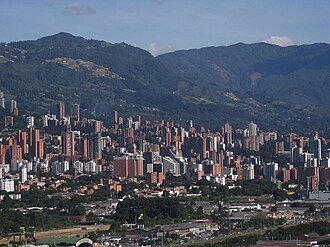
Medellín: the most popular city for remote workers and digital nomads — significantly cheaper than Bogotá, excellent climate (spring-like year-round at 1,495 metres elevation, called the ‘City of Eternal Spring’), strong expat community in El Poblado and Laureles neighbourhoods. Bogotá: capital city, highest altitude (2,600m — some people experience altitude effects for the first week), largest economy, best international flight connectivity. Cartagena: Caribbean coast, colonial architecture, vibrant arts scene — more expensive and more tourist-oriented than the interior cities. Cali: for salsa, warmth, and significantly lower cost of living than Medellín.
Colombia’s AirBnB market is extensive — short-stay lets are widely available and useful for the first month while you find a longer-term rental. For permanent apartment rentals, Colombian landlords typically require Colombian referencias (references from previous landlords) or a fiador (guarantor with Colombian property ownership), which foreign renters cannot easily provide. Property managers (administradores) who work with international tenants are a useful intermediary.
Safety and reality check
Colombia’s reputation has improved dramatically over the past 20 years but safety remains significantly location-dependent. The expat-popular zones in Medellín (El Poblado, Laureles, Envigado) and Bogotá (Chapinero, Usaquén, Zona Rosa) have high safety standards with security infrastructure similar to European city centres. Nighttime travel in unfamiliar areas requires the same caution as any major Latin American city. The UK Foreign Office rates most of Colombia as amber (‘Exercise more caution’) with specific higher-risk regions — check the current FCDO travel advice and local expat communities for neighbourhood-level guidance.
Further reading
- Malaysia MM2H visa guide 2026: the My Second Home long-stay programme
- Australia visa guide 2026: skilled worker, permanent residency and WHV
- Italy visa guide 2026: digital nomad visa, elective residence and working routes
- Ireland visa guide 2026: work permit, critical skills and stamp system explained
- UAE residency guide 2026: Golden Visa, remote work visa and freelance licence