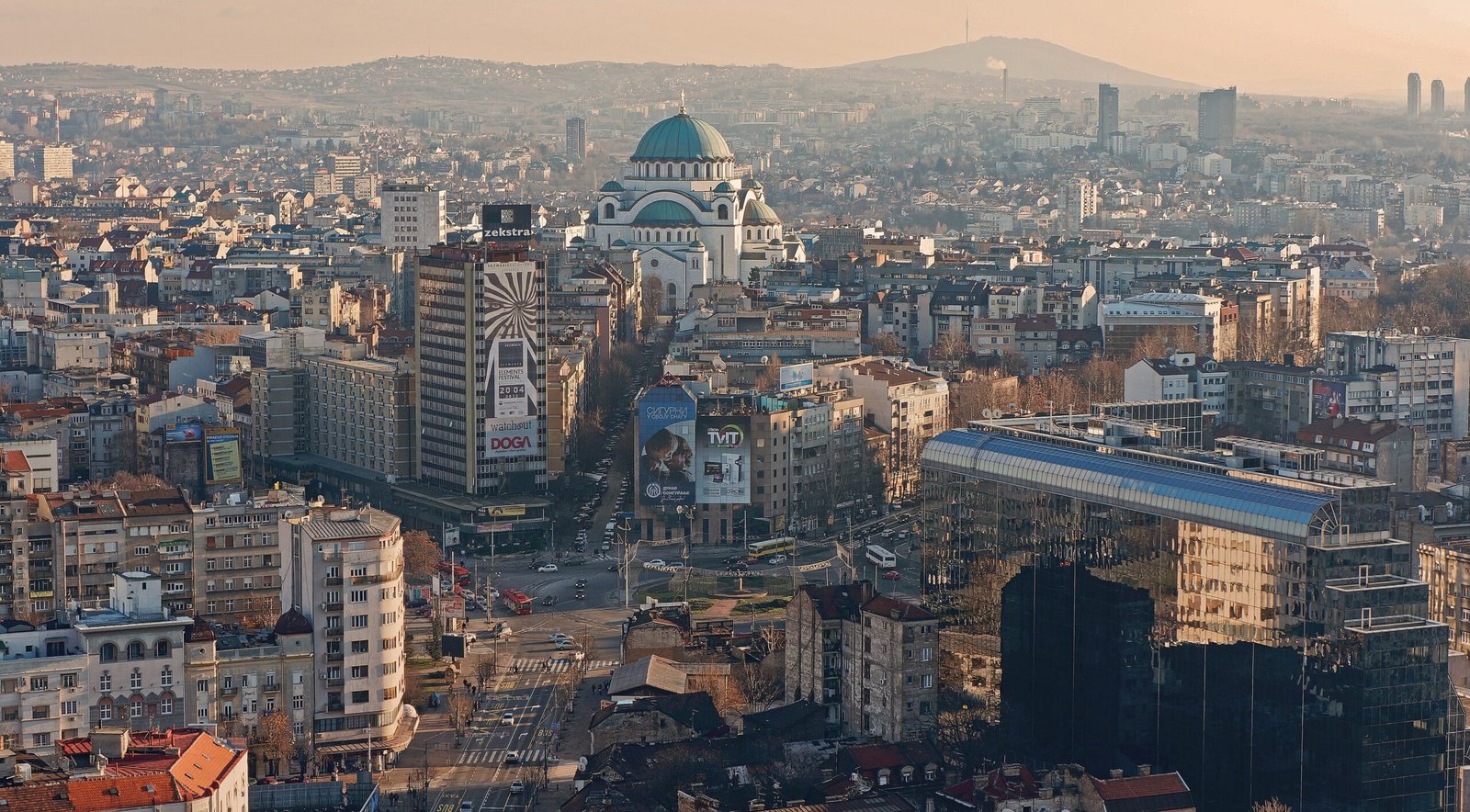
Belgrade is the cheapest capital city in Europe that still offers genuine metropolitan life — a proper city with a formidable nightlife, fast internet, café culture, and a 90-day visa-free stay for most Western passport holders. Here is the full 2026 cost breakdown.
Currency: Serbian Dinar (RSD). Approximate EUR equivalents used. 1 EUR ≈ 117 RSD in mid-2026. Monthly estimates based on July 2026 data from local listings and expat communities.
| Category | Budget | Comfortable | Premium |
|---|---|---|---|
| Accommodation (furnished 1-bed) | EUR 400–650 | EUR 650–1,000 | EUR 1,000–1,800 |
| Food and eating out | EUR 150–250 | EUR 250–400 | EUR 400–700 |
| Transport (bus/metro + Bolt taxi) | EUR 20–50 | EUR 50–100 | EUR 100–250 |
| Utilities (electric, gas, internet, AC) | EUR 60–100 | EUR 100–170 | EUR 170–350 |
| Entertainment, nightlife, gym, socialising | EUR 60–150 | EUR 150–280 | EUR 280–600 |
| Total monthly estimate | EUR 690–1,200 | EUR 1,200–1,950 | EUR 1,950–3,700 |
Why Belgrade is the best-kept secret in European expat life
- Cheapest capital city in Europe for comparable living standards — outcompetes Sofia, Tirana, and Podgorica on city size and infrastructure.
- Visa-free entry for 90 days for UK, EU, US, Canadian, and most Western passport holders — no visa application, just passport control.
- Serbia has some of the fastest fixed broadband in Europe — average speeds in the global top 15, consistently beating France, Spain, and Italy.
- Belgrade’s splavovi (river clubs on the Sava and Danube) and city nightlife scene has international recognition — frequently cited alongside Berlin and Amsterdam.
- Young, English-speaking professional population — tech outsourcing to Serbian developers from Western companies is now a major industry and has built English proficiency across the under-40 population.
- Extremely safe by European capital standards — low violent crime rates and a strong public sense of security in most areas.
Belgrade’s best neighbourhoods
Stari Grad (Old Town): the historic centre — Knez Mihailova pedestrian boulevard, Republic Square, and the Kalemegdan Fortress. Dense, walkable, excellent cafés and restaurants. 1-bed furnished: EUR 650 to 1,000. Savamala: Belgrade’s cultural regeneration district, converted warehouses, street art, young creative crowd, DJ venues. Prices similar to or slightly below Stari Grad. Vračar: quiet residential neighbourhood south of Stari Grad, local market, popular with young professionals and families. EUR 500 to 850. Very walkable to Stari Grad. Novi Beograd: modernist planned city on the other side of the Sava river — functional, affordable (EUR 400 to 650), but architecturally bleak. Good for budget stays; less popular for those who want character.
Serbian food culture
Serbia has a hearty, meat-forward food culture with strong Ottoman and Austro-Hungarian influences. Ćevapi (grilled minced meat sausages with flatbread and ajvar pepper relish) are the national fast food — a serving costs RSD 300 to 500 (EUR 2.60 to 4.30). A burek (flaky pastry filled with cheese, meat, or potato) from a pekara (bakery) costs RSD 100 to 200 (EUR 0.85 to 1.70) and makes a full meal. A traditional kafana (Serbian restaurant with live folk music on weekends) serves a full meal with rakija (fruit brandy) and wine for EUR 10 to 18 per head.
Belgrade’s restaurant scene has modernised significantly in recent years. Skadarlija (the bohemian restaurant street) is traditional and slightly tourist-facing; Savamala has the best contemporary and international restaurants. Groceries at Maxi or Lidl for one week: EUR 30 to 50. Serbian wines from Župa, Vranje, and Fruška Gora are excellent and extremely cheap — a quality bottle from a local winery costs EUR 3 to 8.
The nightlife that put Belgrade on the map
Belgrade’s nightlife is internationally famous and genuinely extraordinary. The splavovi (floating clubs on barges moored along the rivers) operate from spring through autumn. Freestyler, Brodić Fontana, and Club 20/44 are among the best known. In winter, clubs move to converted spaces in Savamala and across the city. A night out in Belgrade — dinner, entry, drinks, taxi home — typically costs EUR 25 to 50. This is 20 to 30 percent of the equivalent cost in London, Berlin, or Amsterdam.
Internet speed: genuinely impressive
Serbia regularly appears in the top 15 countries globally for fixed broadband internet speed. SBB (Serbia Broadband) and Telekom Serbia both offer 500 to 1,000 Mbps fibre plans in Belgrade for EUR 8 to 18 per month — among the cheapest high-speed internet plans in Europe. Co-working in Belgrade: Impact Hub Belgrade, Startit Centre, and the Centar za Promociju Nauke are the main options. Day passes EUR 8 to 15. Many of Belgrade’s independent cafés (Kafeterija, Pablo Disco Bar) have reliable WiFi and power access.
Visa and residency rules
Serbia is not in the EU, Schengen, or EEA. Most Western passport holders can enter and stay visa-free for 90 days per calendar year. There is no requirement to register with authorities for stays under 90 days if staying in a hotel (hotel registers for you); those in private accommodation are technically required to register at the police within 24 hours of arrival — rarely enforced for tourists but required for longer stays.
For stays beyond 90 days, a Temporary Residence Permit (boravišna dozvola) is required. This requires: a registered local address with a tenancy agreement, proof of income (bank statements), health insurance certificate valid in Serbia, and a police registration certificate from a local station. Processing takes 30 to 60 days and must be initiated before the 90-day tourist period expires. Many nomads cycle through 90-day periods with brief exits to North Macedonia or Bosnia.
Healthcare
Serbia’s public healthcare is available to residents with a registered address and is better than some Western expectations — functional and competent for primary care, though overburdened in specialist waiting times. Most expats use private clinics: Euromedik, Bel Medic, and the Bergamo clinic group in Belgrade charge EUR 20 to 45 for a GP consultation and EUR 40 to 80 for specialist appointments. Dental care is excellent quality and extremely cheap — a crown or implant costs 30 to 50 percent of Western European prices and dental tourists from Austria and Germany visit Belgrade specifically for dental work.
Belgrade winters (December to February) are genuinely cold — regular sub-zero temperatures and occasional snow. The city’s energy infrastructure occasionally creaks in cold snaps. If you are planning a stay that includes winter, confirm your apartment’s heating system and double-glazing before signing. The splavovi and outdoor café culture that makes Belgrade magical is largely a spring and summer phenomenon.
Is Belgrade the right base?
Belgrade is an outstanding choice for remote workers who want a proper European city experience at the cheapest possible price. The combination of low cost, fast internet, and an extraordinary social and nightlife scene makes it uniquely appealing for a specific type of expat — one who values urban energy, social life, and cost savings over guaranteed EU travel freedoms or tropical climate. The political context (Serbia is not EU-aligned) is worth monitoring; otherwise, Belgrade delivers a quality of life that significantly exceeds its price tag.
Further reading
- Cost of living in Cape Town, South Africa 2026: expat monthly budget
- Cost of living in Málaga, Spain 2026: digital nomad and expat budget
- Cost of living in Buenos Aires, Argentina 2026: expat monthly budget
- Cost of living in Split, Croatia 2026: expat and digital nomad budget
- Cost of living in Porto, Portugal 2026: expat monthly budget