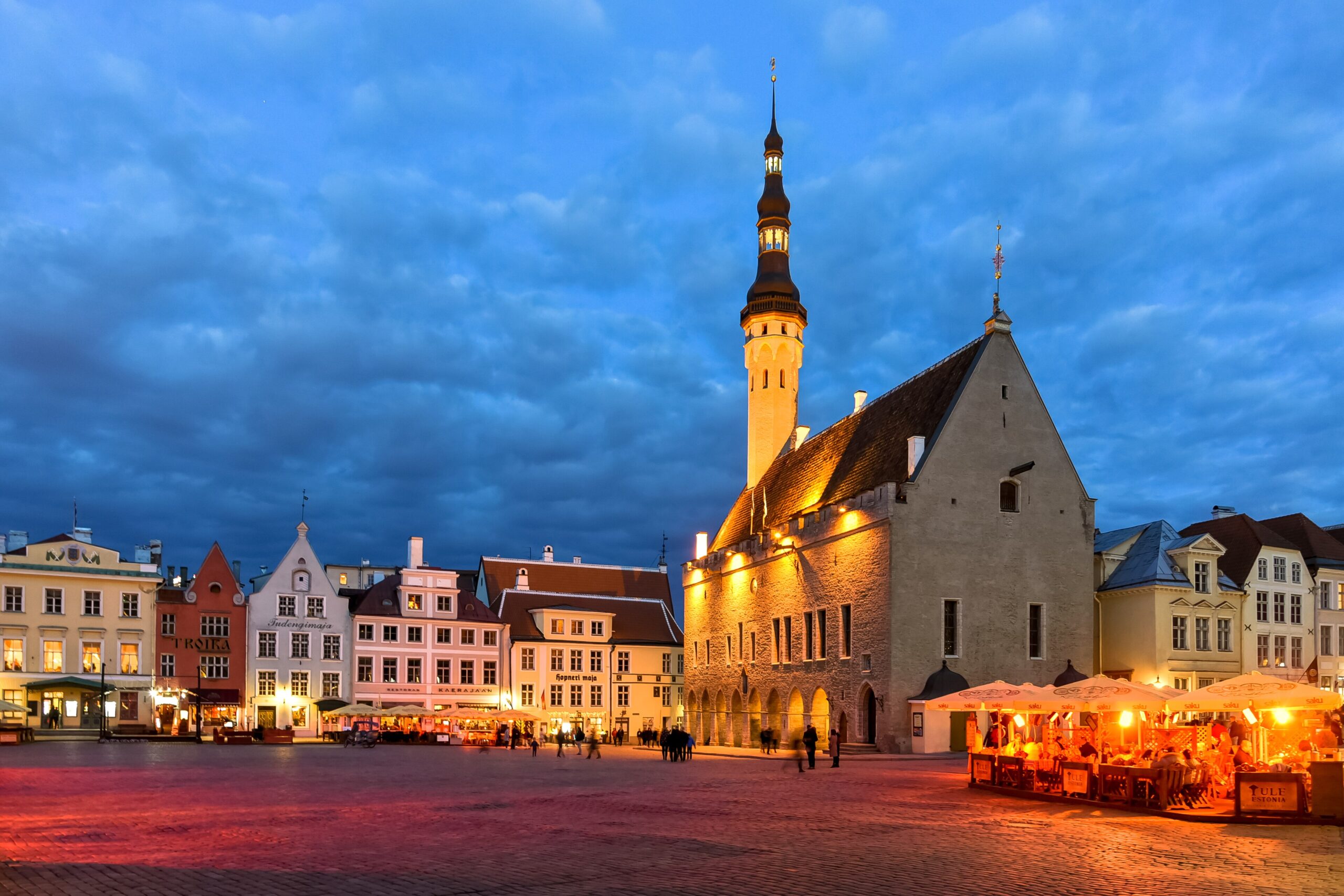
Estonia is Europe’s digital pioneer. Government services run on blockchain, the e-Residency program lets global founders set up Estonian companies remotely, and Tallinn produced unicorns Wise (TransferWise) and Bolt. The Digital Nomad Visa added in 2020 lets you live there with that infrastructure.
Last verified: May 6, 2026.
Estonia digital nomad visa overview
- Initial validity: 1 year
- Non-renewable: Single 1-year stay. Cannot renew or extend in country
- Income threshold: €4,500/month gross (€54,000/year)
- Eligibility: non-EU/EEA citizens working remotely for foreign employers, freelancers, or owners of businesses outside Estonia
- Cost: €100 application fee + €60 fingerprinting + apostille/translations
- Application timeline: 15-30 days at consulate (faster than most EU)
- Schengen access: EU + Schengen since 2007
Why Estonia for nomads
- World’s most digital government: 99% of public services online. e-Residency, e-tax, e-voting
- Tech ecosystem: Wise, Skype, Bolt, Pipedrive, Veriff founded here. Strong startup scene
- English-friendly: Estonia has one of highest English proficiency rates in EU (after Netherlands, Sweden)
- EU + Schengen: easy travel to other EU countries
- Helsinki + Stockholm gateway: 2-hour ferry to Helsinki, day trip to Stockholm
- Low taxes: 20% flat income tax + favorable corporate structure
- Fast internet: world-class fiber infrastructure. 1Gbps available at €25-35/month
- Safety: low crime rates, very safe cities
e-Residency program — separate but synergistic
Estonia’s e-Residency is a digital identity program allowing non-residents to:
- Set up Estonian company: 100% online via e-Residency
- Open Estonian bank accounts: some banks accept e-Residents (LHV most accommodating)
- Sign documents digitally: with EU-recognized digital signature
- Manage taxes online: via e-tax
- EU-based business at low cost: Estonian companies don’t pay corporate income tax until profit is distributed (0% on retained earnings)
Many digital nomads combine: e-Residency for their company structure + Digital Nomad Visa for living in Estonia. The combination is synergistic.
e-Residency cost + process
- Application fee: €100 (lifetime)
- Pickup: Estonian embassies in 50+ countries OR e-Residency cards mailed to Estonia/select EU countries
- Timeline: 4-6 weeks application processing + collection time
- Renewal: every 5 years (free)
Eligibility requirements 2026
- Non-EU/EEA citizen
- Remote work for foreign employer/clients OR owner of foreign-registered business
- Income proof: €4,500/month for 6 months prior to application
- Health insurance: EU-recognized coverage for visa duration
- Accommodation in Estonia: rental contract or accommodation booking
- Background check: apostilled criminal record
- Valid passport: 6+ months remaining
Application process
Step 1: Apply at Estonian consulate (your country)
- Documents: passport, application form, employment/contract letters, 6 months bank statements at €4,500+/month, health insurance, accommodation proof, background check
- Cost: €100 application + €60 fingerprinting (paid in country)
- Timeline: 15-30 days for processing
Step 2: Travel + register in Estonia
After visa issuance, travel to Estonia within 90 days. Within 14 days of arrival:
- Register at Police and Border Guard Board (PBGB) office
- Submit biometrics + photos
- Pay residence permit fee (~€80)
- Receive residence card 1-3 weeks later
Cost of living in Tallinn
Tallinn is small (450K population) but punches above weight. Realistic monthly costs:
- 1-bed apartment in Old Town (Vanalinn): €700-1,200/month (premium for charm + tourism)
- 1-bed apartment in Kalamaja (artsy, gentrifying): €600-900/month
- 1-bed apartment in Kadriorg (residential, parks): €600-900/month
- 1-bed apartment in Mustamäe (cheaper, residential): €450-650/month
- Groceries: €200-350/month
- Restaurants (mid-range): €30-50 for dinner
- Coworking (Lift99, Spring, Workland): €150-300/month
- Transport (Tallinn is FREE for residents): €0 once registered
- Total mid-range nomad: €1,400-2,300/month
Best neighborhoods in Tallinn
Vanalinn (Old Town)
UNESCO-listed medieval old town. Tourist-heavy but living here means walking to everything. Best for those who want historic charm.
Kalamaja
Once-industrial port district turned hipster + creative hub. Like Brooklyn-ifying Tallinn. Cafes, restaurants, art galleries. Most popular nomad neighborhood.
Telliskivi (Creative Hub)
Adjacent to Kalamaja. Coworking, restaurants, bars. Strong nomad + creative community.
Kadriorg
Residential with parks + Russian Imperial palace. Quieter, family-friendly. Less party vibe.
Pirita
Beach + marina. Summer-focused but quiet. Further from center. Family-friendly.
Tax structure on nomad visa
Estonia’s flat tax + corporate structure is unique:
- Personal income tax: 20% flat (one of lowest in EU)
- Tax residency: 183-day rule applies
- Foreign income: taxable in Estonia at 20% if you’re tax-resident. No exemption like Romania has
- Estonian company tax: 0% on retained earnings, 20% on profit distributions (very tax-friendly for reinvestment)
- Social contributions: not required for foreign-employed nomad visa holders
Most nomads on Digital Nomad Visa avoid Estonian tax-residency by staying under 183 days. Combine with travel elsewhere. Or fully tax-resident + leverage Estonian company structure for tax efficiency.
Banking on nomad visa
Estonian banks vary in their welcome to non-residents:
- LHV Bank: most foreigner-friendly. Accepts e-Residents + nomad visa holders
- Swedbank Estonia: traditional bank. May require physical visit + Estonian language
- SEB Estonia: similar to Swedbank
- Wise + Revolut: excellent for daily nomad use. Hold EUR + USD + multi-currency
Most nomads use Wise/Revolut for daily spending + LHV for Estonian-specific needs.
Living in Tallinn — what to know
- Climate: cold winters (-15°C possible January), short days, dark by 4pm. Summers cool + rainy
- Sun reality: June-July sunshine 18+ hours. December darkness 7-8 hours daylight
- English ubiquity: almost everyone under 40 speaks fluent English
- Russian-speaking minority: 25% of population. Important for some service interactions
- Helsinki day trips: 2-hour ferry across Gulf of Finland. Free public transport in Helsinki
- Stockholm gateway: overnight Tallink ferry to Stockholm
Tallinn neighborhoods + the e-Residency synergy
Vanalinn (Old Town) — UNESCO + tourist heart
Cobblestone medieval streets, Town Hall Square, Toompea castle hill. Touristy April-October, magical December. 1-bed €750-1,200/month. Best for short stays + experiencing the medieval vibe daily. Most coworking is just outside.
Kalamaja — hipster quarter + best cafe density
Former fishing village turned creative neighborhood. Wooden houses, Telliskivi Creative City complex, Balti Jaam market, the best brunch in Estonia. 1-bed €700-1,000/month. Most popular nomad neighborhood — walkable to Old Town, 10 min to ferry terminal (Helsinki day trips), and Lift99 (Estonia’s flagship coworking + startup hub) sits here.
Kadriorg — parks + tsarist palaces
Catherine the Great’s summer palace, Kumu art museum, leafy parks. Quieter, family-feel. 1-bed €750-1,100/month. Best for couples or nomads wanting calm; takes 15-20 minutes to reach the rest of the city.
Sopruse / Mustamae — affordable, less character
Soviet-era apartment blocks, but cheap and well-connected by tram. €450-650/month. Best for budget nomads or longer stays where character matters less than savings.
Estonia DN visa + e-Residency: a complete strategy
e-Residency (separate from the visa) lets you register an Estonian company online, manage it from anywhere, and tap EU markets without ever setting foot in Estonia. Combined with the DN visa you can:
- Run an EU company (0% corporate tax on retained earnings, 22% only on dividends paid out)
- Issue invoices to EU clients in EUR through your OU (private limited company)
- Maintain a real Estonian business address (~€20/month with virtual office providers)
- Open a Wise Business or LHV bank account
- Live and work physically in Estonia for 1-2 years
This combination is uniquely powerful: you get an EU company + an EU residency permit + low operational tax, while remaining tax-resident wherever suits you. Estonia’s tax-treaty network (US, UK, Germany, France, Netherlands) is solid.
Caveats: e-Residency is NOT residency. It’s a digital identity for company management. The DN visa is the actual residency permit. Don’t conflate them. Estonian OU profits are tax-deferred but the moment you distribute as dividends, 22% applies. Many e-residents reinvest profits or keep dividends low.
Cost of living — Tallinn 2026
- 1-bed apartment central: €700-1,100/month
- Coworking (Lift99, Spring Hub, Workland): €150-280/month
- Restaurant lunch menu: €8-13; dinner mains €12-22
- Beer: €4-6 craft, €3-4 local
- Groceries: €200-300/month (Selver, Rimi, Prisma)
- Public transport: FREE for registered Tallinn residents
- Bolt rides: €4-8 most central
- Total comfortable: €1,800-2,400/month
Common Estonia DN visa pitfalls
Pitfall 1: e-Residency confusion. Many applicants think e-Residency entitles them to live in Estonia. It does not. Apply for the DN visa separately at a consulate or VFS center.
Pitfall 2: Income proof from cryptocurrency. Estonian PBGB (police) accepts only documented bank-statement income. Crypto-funded nomads must convert to fiat through a regulated exchange, hold for 3+ months, and show consistent banking history.
Pitfall 3: Winter reality check. Tallinn’s December/January days have 6 hours of daylight (sunrise 9:15, sunset 15:30). Visit in February before committing to a year. Many nomads love it; others bail by month three.
Related: EU nomad visa comparison · Portugal D8 · Spain DN visa.
Estonia DN visa timeline — start to first paycheck in Tallinn
3-5 months from application to fully set up:
- Month 1: Get e-Residency first (optional but recommended) — apply online at e-resident.gov.ee, €120 fee, biometrics at nearest pickup location (~3-4 weeks). Gather DN visa documents: passport, employment/contracts showing €4,500/month, bank statements (6 months), health insurance, accommodation.
- Month 2: Apply for DN visa at Estonian consulate or VFS center. Fee €100. Processing 30-60 days. Some applicants travel to nearest Estonian embassy (Helsinki is popular for Americans).
- Month 3: Visa approved. Fly to Tallinn. Register address at Tallinn city hall. Apply for ID-card if planning longer stay (separate from e-Residency card).
- Month 4-5: Open business bank account (Wise Business, LHV, or Swedbank — LHV is most e-Resident-friendly). Register Estonian OU company if doing the e-Residency strategy. Begin Tallinn life.
Estonia myths + reality
Myth 1: e-Residency = residency. No. e-Residency is a digital identity for managing an Estonian company online. The DN visa is the actual residence permit. Confusing them is the most common mistake.
Myth 2: It’s freezing year-round. Tallinn summers (June-August) hit 22-26C with 18 hours of daylight. May-September is genuinely beautiful. November-February IS dark (4-6 hours of daylight) — visit in winter before committing.
Myth 3: Estonia is too small/quiet. Tallinn (450K) is small but punches above weight. Direct ferries to Helsinki (2 hrs), flights to Stockholm/Copenhagen/Berlin (90 min). Latvia + Lithuania accessible by 4-hour bus.
Myth 4: 0% corporate tax means you pay no tax. Estonian companies pay 0% on RETAINED earnings, but 22% when distributed as dividends. If you draw salary, social tax + income tax apply. Talk to Estonian accountant before assuming you’ll pay nothing.
Estonia vs Latvia vs Lithuania nomad visas
The three Baltics compete on overlapping markets:
- Estonia DN visa: €4,500/month, 1-year + renewable, e-Residency synergy
- Latvia Long-Stay Visa for remote workers: €2,857/month, 1-year, simpler but no e-Residency equivalent
- Lithuania Startup Visa: for tech founders, business plan required, 1-year
Estonia wins on tech ecosystem + e-Residency. Latvia wins on lowest income threshold + Riga’s larger size + easier cost. Lithuania wins on EU access + Vilnius cultural depth.
Related: Work Abroad guides · EU nomad visa comparison · best European nomad cities.
Official Estonian government resources
- Estonian Police + Border Guard (PBGB): politsei.ee/en — DN visa, residence permits
- e-Residency portal: e-resident.gov.ee
- Estonian Tax + Customs Board: emta.ee/en
- Tallinn city services: tallinn.ee — free public transport for residents
What to bring vs. buy locally
Estonia is sophisticated retail-wise: IKEA Tallinn, H&M, Apple Store, Decathlon. Cost-of-living-adjusted, retail prices match Western Europe. What to prioritize:
- Bring: serious winter gear (-15C possible January), light therapy lamp (winter darkness is real), prescription meds (3 months minimum, get prescriptions translated to Estonian or English), electronics (230V Type C/F).
- Buy locally: furniture (IKEA + Mobel Estonia), winter boots (Reet Aus, Estonian designer brands), bedding, kitchenware.
- Specifically Estonian: bring proof you can manage 6 months without local employment (PBGB sometimes asks). Bring laptop with WireGuard or VPN preconfigured (some US streaming services geoblock).
Estonian language quick wins
Estonian is Finno-Ugric (related to Finnish, distantly to Hungarian). Hard but English is widespread in Tallinn. Useful basics:
- Hello: Tere (TEH-reh)
- Thank you: Aitäh (eye-tah)
- Please / you’re welcome: Palun
- Yes / no: Jah / Ei
- Excuse me: Vabandage
- How much?: Kui palju?
- I don’t understand: Ma ei saa aru
- English?: Inglise keelt?
- Coffee: Kohv
- Beer: Õlu
- Train station: Raudteejaam
- Goodbye: Nägemist
Bottom line: Estonia DN visa
Estonia is best for nomads serious about building an EU business via e-Residency, who appreciate digital-government efficiency, and don’t mind 4-month dark winters. The combination of OU company structure + DN visa is uniquely powerful for solo founders + freelancers earning EU client revenue. Trade-off: cost of living is higher than Hungary or Romania, weather is challenging.
Estonia winter strategy — what makes the difference
The single biggest deal-breaker for Estonia DN visa holders is winter darkness. December 21 has 6 hours 4 minutes of daylight in Tallinn (sunrise 9:18, sunset 15:22). Light therapy lamps (10,000 lux, 30 minutes morning), vitamin D supplements (2,000-4,000 IU daily), and twice-weekly sauna visits are standard nomad practice for surviving the dark months.
Counterintuitively, summer compensates dramatically. June 21 has 18 hours 41 minutes of daylight (sunrise 4:02, sunset 22:43). “White nights” mean reading outdoors at 11 PM in shorts. Estonians embrace the contrast — winter as deep introspection + work focus, summer as pure outdoor euphoria. Many DN visa holders schedule their year around this rhythm: fly home for December, return for the long days April-October.
Visa-accepted health insurance
Genki Native — built for Estonia DN visa applications
Comprehensive private health insurance accepted by EU consulates for long-stay visa applications (Portugal D7, Spain NLV, Italy DN, Hungary White Card, Romania DN, Estonia DN). No co-pays, no waiting periods, full European coverage. The German parent company has been underwriting expat insurance since 2008.
Get a Genki Native quote → affiliate link — we earn a commission, you pay nothing extra
See it in context: compare this visa against 35+ other nomad, freelancer, and retirement visas worldwide in comparison of all 39 nomad visas — income thresholds, tax treatment, family rules, path to PR. Updated quarterly from official immigration sources.
FAQ
Can I extend the digital nomad visa beyond 1 year?
Officially no — the visa is one-time non-renewable. After 1 year, you must leave Estonia. Some nomads transition to other Estonian visas (e.g., self-employed permit, work permit if Estonian employer hires).
Should I get e-Residency separately from the visa?
Yes, recommended. e-Residency is for company setup + global business; nomad visa is for living in Estonia. They serve different purposes. Many nomads have both.
Can I bring family?
Yes — spouse + children under 18 can apply for dependent residence permits. Each pays application fees. Spouse can work in Estonia (any role). Children attend Estonian or international schools.
Is Estonian language required?
Not for daily life — English is widely spoken. For permanent residency or citizenship eventually, Estonian B1 required. Estonian is one of Europe’s hardest languages (Finno-Ugric, 14+ noun cases).
What about post-visa options?
After 1-year nomad visa, can leave Estonia and apply for new visa from abroad (most do this). Or transition to: Estonian self-employed permit (need Estonian-registered company), EU Blue Card if Estonian employer offers €60K+ salary, or family reunification if married to EU citizen.
Path to permanent residency or citizenship?
Nomad visa alone doesn’t lead to PR. Need 5 years of continuous residence on a long-term visa (work permit, family permit). Then 8 years total for citizenship + B1 Estonian. Estonia generally doesn’t allow dual citizenship.
Bottom line: Estonia for nomads
Estonia works for: tech-focused nomads earning €4,500+, those who appreciate digital infrastructure, entrepreneurs leveraging e-Residency, anyone seeking small-scale European city with EU access. Estonia doesn’t work for: those wanting cheap cost of living (it’s mid-range EU), people needing larger international scenes, those uncomfortable with cold winters + short daylight in winter.
Related: Czech Zivno visa · Hungary White Card · best digital nomad visas ranked.
✓ Last verified: May 6, 2026.
Further reading
- Cost of living in Málaga, Spain 2026: digital nomad and expat budget
- Cost of living in Buenos Aires, Argentina 2026: expat monthly budget
- Cost of living in Split, Croatia 2026: expat and digital nomad budget
- Cost of living in Porto, Portugal 2026: expat monthly budget
- Cost of living in Penang, Malaysia 2026: expat monthly budget